


Part 2 of “The Future of Work” series.
The Coming Decade of AI Shockwaves: Winners, Losers, and the New Corporate Order
How artificial intelligence will reshape organisations from pyramid to diamond — and who will survive the transition
Last month, I spoke with a marketing director at a large company who told me something that made my stomach drop. Her team of 12 people — analysts, coordinators, junior associates — had been cut to four. Not because of layoffs or budget cuts, but because AI could now do most of their work.
“We used to need three people to run a campaign analysis,” she explained. “Now I can do it myself with Claude in about 20 minutes.”
She’s not alone. Across the world, a quiet revolution is underway that will fundamentally reshape how organizations look, feel and function over the next decade. It’s not the robot apocalypse that science fiction warned us about. It’s something more subtle and perhaps more profound: the systematic hollowing out of entire layers of white-collar work.
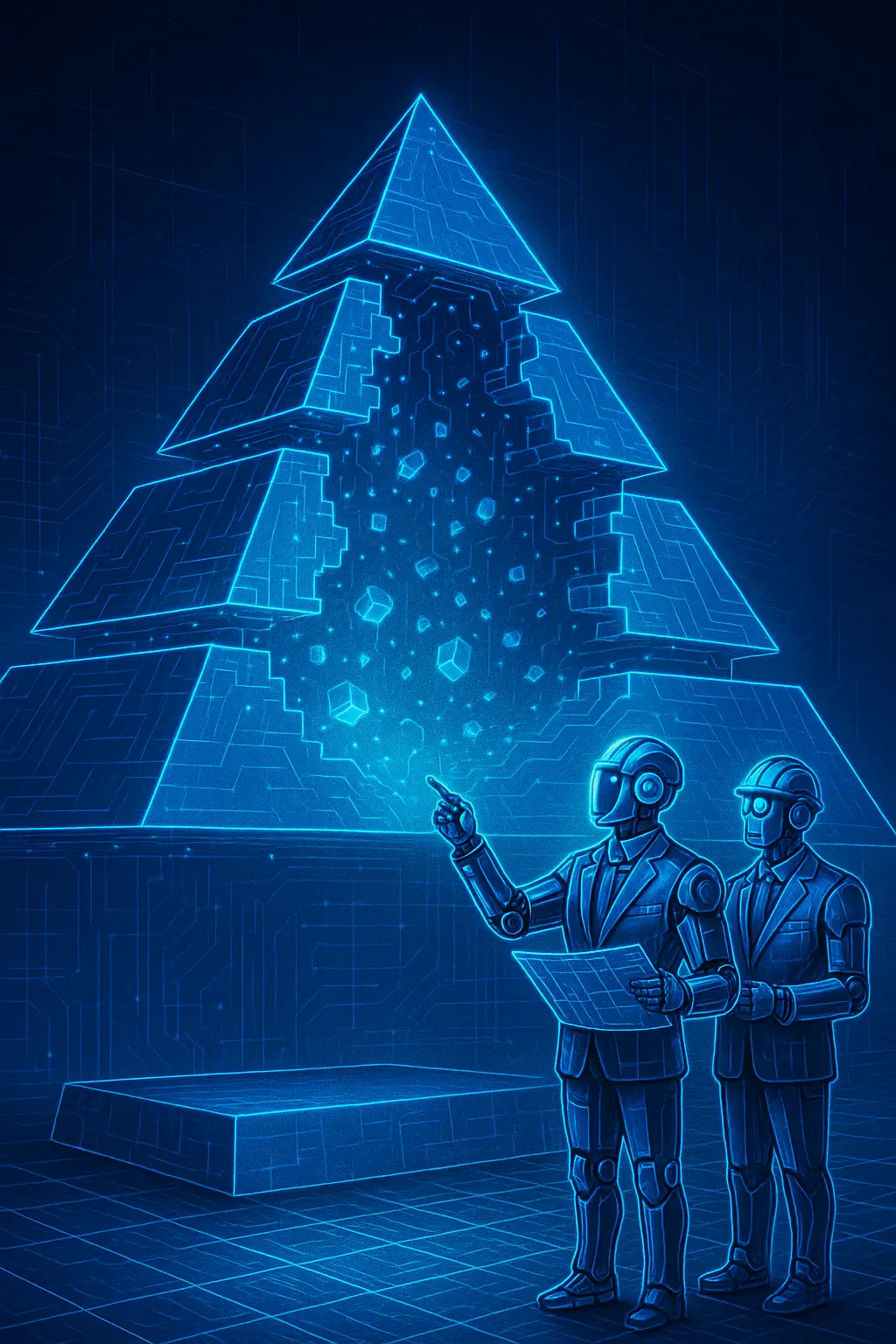
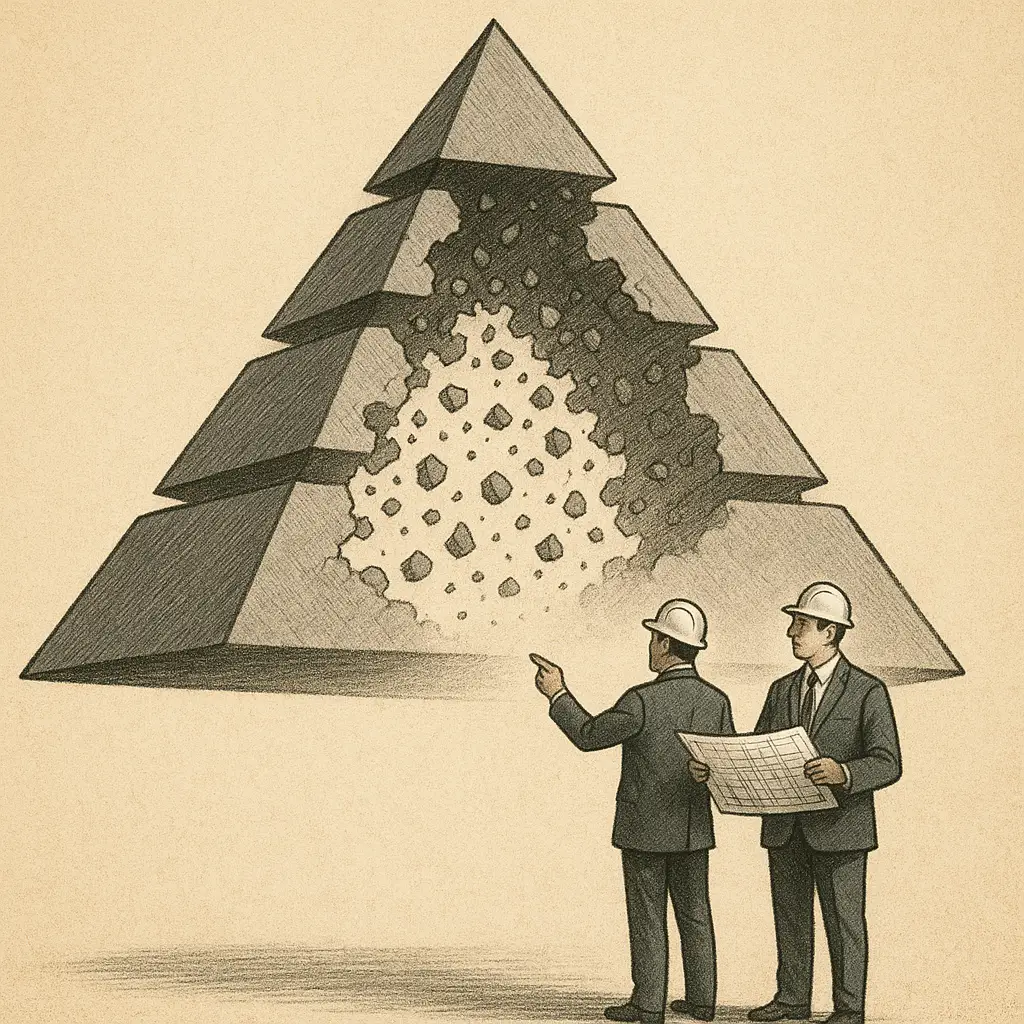
According to new research on AI’s organizational impact through 2035, we’re entering what experts call “the great flattening” — a period where traditional corporate hierarchies will be compressed, middle management will shrink even more dramatically, and the already hollowed-out pyramid structure of organizations will morph into something that looks more like a diamond.
The implications are staggering. By 2030, research suggests that AI-driven automation could handle nearly 30% of hours worked in the economy — a sharp jump from earlier predictions. But unlike previous waves of automation that primarily affected manufacturing and routine manual labor, this transformation is coming for the cubicle class: the analysts, coordinators, junior associates and middle managers who form the backbone of the corporate workforce .
The Two Faces of AI at Work
To understand what’s coming, you need to grasp the difference between the two types of AI reshaping workplaces: generative AI and agentic AI.
Generative AI — the ChatGPTs and Claude AIs of the world — is already augmenting human workers. It’s the writing assistant that helps craft emails, the coding companion that suggests solutions, the analyst that can crunch numbers in seconds instead of hours. This technology is making individual workers more productive, but it’s not necessarily eliminating jobs wholesale.
Agentic AI is different. These are AI systems that can act autonomously, making decisions and taking actions without constant human oversight. Think of an AI agent that can manage an entire customer service inquiry from start to finish, or one that can coordinate supply chain logistics across multiple vendors. This technology doesn’t just make humans more efficient — it can replace entire job functions.
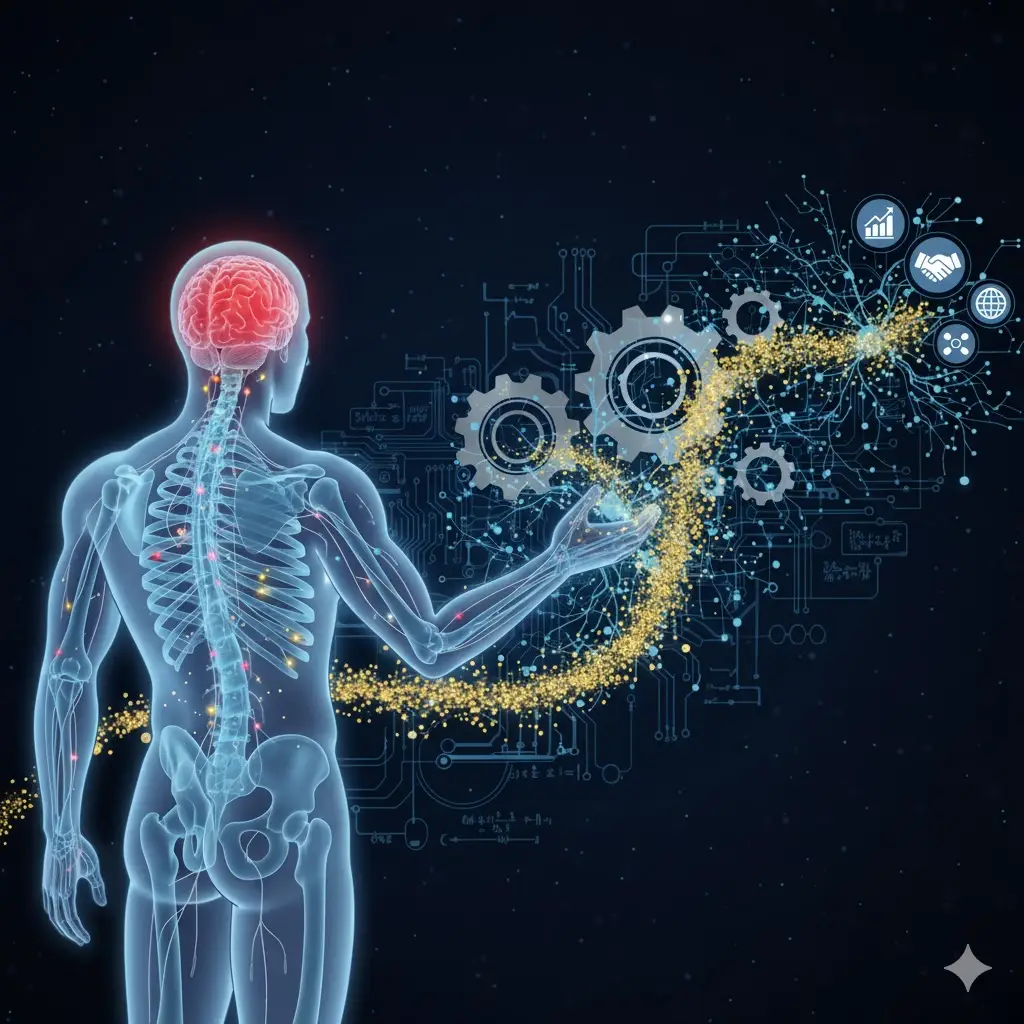
We’re moving from AI as a tool to AI as a colleague. And that shift changes everything about how companies are structured.
The numbers back this up. A recent survey found that 88% of global C-suite leaders plan to accelerate AI integration in the coming year. More tellingly, organizations are expected to heavily invest in training programs, with 37% of executives globally planning to invest in learning and development to help employees work with AI tools.
But here’s the uncomfortable truth: not everyone will make the transition.
The Great Middle Management Squeeze
Perhaps nowhere will the change be more dramatic than in middle management. Gartner predicts that from 2026, 20% of organizations will start to use AI to flatten their structures, eliminating over half of middle-management positions.
It makes brutal sense. Much of what middle managers do — tracking project status, compiling reports, routing communications, coordinating between teams — can be handled more efficiently by AI systems. Why pay a $150,000-a-year operations manager when an AI agent can monitor workflows, flag issues, and coordinate responses 24/7?
I spoke with a former project manager at a tech consulting firm, who experienced this firsthand. His role overseeing a team of junior analysts disappeared not through a dramatic layoff, but through what he calls “death by a thousand cuts.”
“First, they introduced AI tools that could do the basic analysis work,” he told me. “Then my reports started getting generated automatically. Then the scheduling and coordination got handed off to an AI assistant. Pretty soon, I was managing the AI more than managing people.”
People in these roles are now retraining as what companies call a “fusion role” — part strategist, part AI orchestrator. But they’re the lucky ones. Many middle managers won’t make the leap.
The research is clear about what’s replacing them: fewer human managers with much larger spans of control, supported by AI systems. A single manager in 2030 might effectively lead a team of 20 humans and dozens of AI agents. It’s a radically different management paradigm — less taskmaster, more conductor of a human-AI orchestra.
The Vanishing Entry Level
But it’s not just middle management that’s disappearing. The traditional entry-level pipeline is also under threat.
Those first jobs out of college — junior analyst, marketing coordinator, administrative assistant — have historically served as crucial stepping stones for career development. They’re where young professionals learn workplace norms, develop skills, and prove themselves worthy of promotion.
Now, many of those roles are becoming automated away. Why hire a junior analyst to compile market research when AI can scan thousands of sources and produce a comprehensive report in minutes? Why employ a marketing coordinator to manage campaign timelines when AI can track deliverables, send reminders, and flag potential issues automatically?
This is creating a missing rung problem. If the entry-level jobs disappear, how do people develop the skills and experience they need for senior roles?
The implications extend beyond individual careers. Companies are realizing they may need to fundamentally rethink how they develop talent. Some are experimenting with “AI apprenticeships” where new hires work directly with senior employees and AI systems, skipping the traditional junior role entirely.
Others are creating what they call “AI-native roles” — positions that exist specifically to manage, train, or work alongside artificial intelligence systems. Job titles like “AI Prompt Specialist,” “Human-AI Team Coordinator,” and “AI Ethics Officer” are becoming increasingly common.
The Rise of the Expert Generalist
While some roles are disappearing, others are expanding dramatically. The sweet spot appears to be what researchers call “expert generalists” — professionals who combine deep domain expertise with the ability to effectively leverage AI tools.
These are the lawyers who use AI to draft contracts but provide strategic counsel humans crave. The marketing directors who let AI handle campaign analysis but focus on creative strategy and brand storytelling. The financial advisors who use AI for portfolio analysis but excel at the human touch of client relationships.
Technical fluency is becoming table stakes. You don’t necessarily need to code, but you need to understand how to work with AI, how to prompt it effectively, how to verify its outputs, and how to integrate it into your workflow.
This shift is creating a new class divide in the workplace. Those who can successfully partner with AI are seeing their productivity — and their value — skyrocket. Those who resist or struggle with the technology are finding themselves increasingly marginalized.
The data supports this trend. Companies that have successfully integrated AI report that their most valuable employees are those who’ve learned to orchestrate both human teams and AI systems. These hybrid leaders command premium salaries and have become among the most sought-after professionals in the market.
The Diamond Shape of Tomorrow
By 2035, the traditional corporate pyramid — with many junior employees supporting fewer senior ones — will likely have evolved into something that looks more like a diamond.
At the bottom, there will be fewer entry-level positions, as AI handles much of the routine work that junior employees traditionally performed. In the middle, there will be a concentration of highly skilled professionals who can effectively work with AI — the expert generalists who represent the new center of organizational value. At the top, there will be a compressed layer of senior leaders focused on vision, strategy, and the uniquely human aspects of leadership.
This diamond structure will be supported by what researchers call “elastic workforces” — networks of contractors, freelancers, and project-based teams that can be assembled and disbanded as needed. Think of it as the “Avengers model” of corporate organization: a small core team that can quickly assemble specialized expertise for specific challenges.
Some companies are already experimenting with this model. NVIDIA’s CEO has spoken about deploying 100 million AI “digital employees” alongside 50,000 human workers. While that specific ratio may be extreme, the concept isn’t far-fetched for large enterprises by 2030.
The Survival Guide
So who survives this transformation, and who doesn’t?
The winners appear to fall into several categories:
The AI Orchestrators: People who can effectively manage and coordinate AI systems while maintaining strategic oversight. Think of them as conductors leading an orchestra of both human and artificial intelligence.
The Irreplaceably Human: Professionals in roles that require deep emotional intelligence, complex problem-solving, or hands-on skills that AI can’t replicate. This includes therapists, skilled craftspeople, and jobs requiring physical presence and dexterity.
The Creative Strategists: Those who can use AI to handle routine tasks while focusing their human energy on innovation, creativity, and high-level strategic thinking.
The Bridge Builders: Professionals who can translate between technical AI capabilities and business needs, helping organizations navigate the human-AI integration.
The losers, unfortunately, are likely to be:
The Routine Processors: Workers whose jobs primarily involve collecting, organizing, or analyzing information in predictable ways.
The Coordination Layer: Middle managers whose primary value comes from routing information and coordinating routine activities.
As I finished my conversation with that marketing director whose team had shrunk from 12 to four, I asked her if she missed the old way of working.
The AI Resisters: Professionals in affected fields who refuse to learn how to work effectively with AI systems.
The Human Cost
It’s important to acknowledge that these changes come with real human costs. The World Economic Forum projects that by 2027, about 83 million jobs will be displaced while 69 million new jobs are created. That’s a net loss of 14 million positions globally, and the transition won’t be smooth or equally distributed.
The research suggests that retraining programs will be crucial, but they’ll need to be more sophisticated than traditional approaches. Simply teaching displaced workers to “code” isn’t enough. The new economy will require what experts call “AI fluency” — the ability to work effectively with artificial intelligence in whatever domain you specialize in.
Some forward-thinking companies are already investing heavily in this transition. They’re creating internal AI academies, partnering with universities on reskilling programs, and developing new career pathways that account for the changing nature of work.
But the responsibility can’t fall entirely on employers. Workers, too, need to take ownership of their own adaptation. The most successful professionals in the coming decade will be those who actively embrace AI as a tool to amplify their human capabilities rather than resist it as a threat.
A Different Kind of Future
But do I think it’s all bad? Honestly, No. The work that remains may well be more interesting. Instead of managing people doing routine tasks, we may well be able to focus on strategy, creativity, and the stuff that really matters like sales and customer relationships. The AI handles the grunt work, and we can handle the thinking.
That might be the most hopeful vision of the coming decade: not a future where AI replaces human workers, but one where it liberates them from drudgery to focus on uniquely human contributions.
The organizational transformation ahead won’t be easy. Companies will need to navigate complex ethical questions about worker displacement, retraining, and the distribution of AI-driven productivity gains. Society will need to grapple with supporting workers through the transition and ensuring that the benefits of AI don’t accrue only to capital owners.
But if we handle it thoughtfully, the diamond-shaped organizations of 2035 might be more human-centered than the pyramid-shaped ones of today — places where people do work that truly leverages their creativity, empathy, and strategic thinking, while AI handles the routine tasks that, let’s be honest, most of us would rather not do anyway.
The question isn’t whether this transformation will happen. It’s already underway. The question is whether we’ll manage it in a way that creates opportunity and prosperity for more people, or whether we’ll let it exacerbate existing inequalities and leave too many workers behind.
The choices we make in the coming years — as individuals, organizations, and as a society — will determine which future we get.