



Part 1 of “The Future of Work” series.
From Cubicles to Restructures: How Strategy Consultants Changed Work Forever
How a handful of consulting firms spent 50 years dismantling the workplace — one reorg at a time
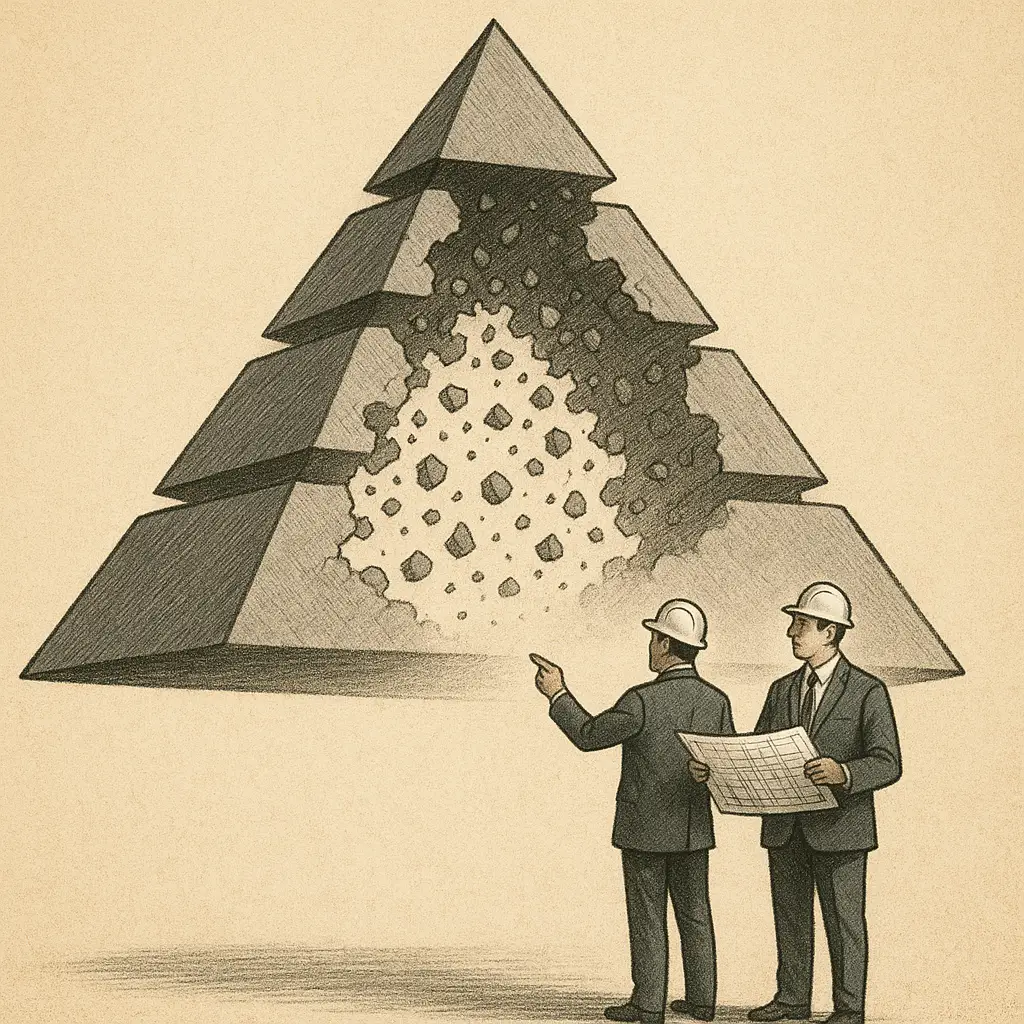
In 1975, if you worked at a big company, your career path was as predictable as a sitcom plot. You’d start in the mailroom, work your way up through clearly defined layers of management, and retire with a gold watch after 30 years. Your boss had a boss who had a boss, and everyone knew their place in the pyramid.
Today, that world might as well be ancient history. The modern workplace is a constantly shifting maze of “agile squads,” “cross-functional teams,” and “matrix organizations” that reorganize with the frequency of a teenager changing their Spotify playlist. The org chart that seemed etched in stone has become more like a whiteboard — constantly erased and redrawn.
What happened? How did we go from the rigid corporate hierarchies of the Mad Men era to today’s fluid, “optimized” organizations that seem to restructure every year or two?
The answer lies in a revolution that’s been hiding in plain sight for half a century — one orchestrated not by tech entrepreneurs or labor activists, but by an elite cadre of management consultants from firms like McKinsey, Boston Consulting Group, and Bain & Company. These are the architects of efficiency thinking, and their influence on how we work has been nothing short of transformational.
The Old World Order
To understand how dramatically things have changed, you have to appreciate what came before. In the 1970s, a typical Fortune 500 company looked like a wedding cake — lots of layers, with each tier smaller than the one below it. General Motors had nine levels of management between the factory floor and the CEO. A middle manager might supervise just four people, creating towering hierarchies that would make a pharaoh jealous.
These weren’t accidents of bureaucracy — they were features. Companies valued stability and control above all else. Information flowed up the chain of command like water through a series of locks, each level adding its own analysis and approval. Decision-making was deliberately centralized because, frankly, lower-level employees didn’t have access to the data they’d need to make informed choices.
The workforce composition reflected this philosophy. In a typical manufacturing company, you’d find armies of production workers overseen by layers of supervisors, all supported by vast pools of clerical staff — typists, file clerks, secretaries. One executive might have their own personal assistant. Multiple departments handled what a single software system does today.
It was inefficient by modern standards, but it worked for its time. Markets were stable, competition was predictable, and companies could afford to carry extra people because growth was steady. The social contract was clear: show up, follow the rules, and the company would take care of you.
Then the consultants arrived.
The Efficiency Evangelists
The transformation didn’t happen overnight. It began in the 1980s when a handful of elite consulting firms started preaching a new gospel: efficiency. McKinsey, BCG, and Bain weren’t just selling advice — they were selling a fundamentally different way of thinking about organizations.
These firms had a compelling pitch. American companies were getting hammered by Japanese competitors who seemed to do everything faster and cheaper. The old bureaucratic hierarchies weren’t just slow — they were expensive. All those middle managers and support staff were eating into profit margins.
The consultants had data, frameworks, and most importantly, success stories. They could point to companies that had “reengineered” their operations and seen dramatic improvements in efficiency and profitability. Their message was seductive: Why accept mediocrity when you could optimize?
The first wave hit in the late 1980s and early 1990s with something called Business Process Reengineering, or BPR. The concept, popularized by consultant Michael Hammer, was radical in its simplicity: Instead of incrementally improving existing processes, companies should blow them up and start over.
“Don’t automate, obliterate,” became the rallying cry.
The results were swift and brutal. Companies that embraced BPR didn’t just trim fat — they performed organizational liposuction. Entire layers of middle management disappeared. The tall pyramids of the 1970s were replaced by flatter structures with wider “spans of control” — meaning each manager now supervised more people.
General Electric, under CEO Jack Welch, became the poster child for this approach. The company systematically removed bureaucracy and pushed decision-making down to lower levels. At one GE factory making circuit breakers, management levels were cut from five to three. Workers were organized into self-directed teams that handled responsibilities previously managed by supervisors. The results were impressive: costs dropped by 30% and production times shrank dramatically.
Other companies took notice. By 1993, up to 60% of Fortune 500 companies had initiated reengineering efforts. The era of “delayering” had begun.
The Great Hollowing Out
What followed was one of the most dramatic transformations in corporate history — the systematic dismantling of middle management.
The math was compelling to executives under pressure to deliver quarterly results. Why pay five middle managers when you could restructure the work to need only two? Why maintain layers of supervisors when technology could automate much of their oversight function?
The consultants provided the intellectual cover for what was essentially a massive downsizing campaign. They reframed layoffs as “organizational optimization” and “process improvement.” They created frameworks and methodologies that made cutting jobs seem scientific rather than simply cost-driven.
Take Zero-Based Budgeting, a concept that had a renaissance in the 2010s. Instead of using last year’s budget as a starting point, ZBB requires managers to justify every expense — including every employee — from scratch. When private equity firm 3G Capital applied this approach to Kraft Heinz after 2015, the company’s workforce dropped from 46,600 to 41,000 in just 15 months.
The human cost was enormous, but the efficiency gains were real. Companies became leaner and more responsive. Decision-making accelerated when there were fewer layers to navigate. Information flowed more freely when it didn’t have to pass through multiple hierarchical filters.
But something else was happening too — the nature of work itself was changing.
The Outsourcing Avalanche
As companies stripped away internal layers, they discovered they could also strip away entire functions. Why maintain a large in-house IT department when you could outsource those services to specialists? Why keep accounting clerks on payroll when you could send that work to a shared services center in India?
The 1990s and 2000s saw an unprecedented wave of outsourcing, enabled by improving technology and globalization. Functions that had been considered core to the business — customer service, manufacturing, even research and development — were suddenly fair game for external providers.
The consulting firms were instrumental in this shift, helping companies identify their “core competencies” and farm out everything else. The logic was irresistible: focus your internal talent on what makes you unique, and let specialists handle the rest.
By 2000, the global outsourcing market had reached roughly $100 billion. Companies discovered they could maintain the same capabilities with dramatically smaller internal workforces. The boundary of the firm became porous — your “department” might include employees on three different continents working for two different companies.
This wasn’t just about moving jobs overseas (though plenty of that happened). It was about fundamentally reimagining what a company should look like. The vertically integrated corporations of the 1970s gave way to networked organizations that coordinated work across multiple partners and suppliers.
The Agile Revolution
By the 2010s, efficiency thinking had evolved again. It wasn’t enough for companies to be lean — they also had to be fast. The rise of tech disruption meant that even optimized organizations could be rendered obsolete overnight if they couldn’t adapt quickly enough.
Enter the next wave of consultant-driven transformation: agile methodologies, design thinking, and “digital transformation.” These approaches, borrowed from software development, promised to make large organizations as nimble as startups.
Companies began reorganizing into “squads,” “tribes,” and “chapters” — borrowing terminology from Spotify’s famous organizational model. Traditional departments were broken apart and reassembled into cross-functional teams focused on specific products or customer segments.
The consulting firms were ready with new frameworks to guide this transition. McKinsey published extensively on “agile transformations.” BCG introduced concepts like the “bionic organization” that combined human and artificial intelligence. Bain worked with private equity clients to implement these models at portfolio companies.
The result was organizations that looked nothing like their predecessors from just a few decades earlier. Hierarchy hadn’t disappeared, but it had become more fluid and temporary. Teams formed around projects and dissolved when the work was done. Employees were expected to be adaptable, moving between roles as needs changed.
The New Normal
Today’s workplace would be unrecognizable to a 1970s manager. The typical enterprise now operates with dramatically fewer layers, smaller core teams, and extensive networks of contractors and partners. A marketing department that once employed 50 full-time staff might now consist of 20 employees plus a rotating cast of freelance designers, copywriters, and social media specialists.
The span of control that once averaged around 1 manager per 4 employees has widened to roughly 1 per 10. Middle managers haven’t disappeared entirely, but their roles have been transformed. Instead of supervising and controlling, they’re expected to coordinate and facilitate. At worst this has seen coordinators with little technical expertise thrive. But at its best this has seen hybrid technical specialists, managing both people and projects.
Career paths that once resembled ladders now look more like jungle gyms. Employees move laterally between functions, take on project-based roles, and develop skills across multiple disciplines. The idea of spending 30 years climbing a single corporate hierarchy seems quaint.
The data tells the story. Manufacturing employment in the US peaked at 19.5 million in 1979 and has fallen to less than 13 million today. Office support roles — typists, file clerks, secretaries — have largely vanished, replaced by software and self-service systems. Meanwhile, roles that barely existed in 1975 — data scientists, user experience designers, agile coaches — are now in high demand.
The Unintended Consequences
This transformation has brought real benefits. Companies are more efficient, responsive, and innovative than they were 50 years ago. Products get to market faster, customer service is more responsive, and organizations can pivot quickly when conditions change.
But the human cost has been significant. The stable career paths and long-term employment that characterized the postwar era have largely disappeared. Job security is now measured in years rather than decades. The social contract between employers and employees has been rewritten, with companies expecting more flexibility while offering less stability.
Workers have had to become more adaptable, constantly upgrading their skills and preparing for the next reorganization. The psychological burden of perpetual change is real — surveys show that even successful employees report higher stress levels and less job satisfaction than their predecessors.
There’s also a growing recognition that some of this optimization may have gone too far. The extreme cost-cutting at companies like Kraft Heinz gutted long-term capabilities in pursuit of short-term efficiency gains. The company later had to write down billions in assets after its brands lost market share to more innovative competitors.
The Consultants’ Legacy
Through it all, the consulting firms have thrived. McKinsey’s revenue has grown from roughly $100 million in 1980 to over $12 billion today. BCG and Bain have seen similar growth. They’ve successfully positioned themselves as the architects of organisational change, with each new framework generating fresh demand for their services.
Their influence extends far beyond their direct client work. The frameworks they’ve developed — from business process reengineering to agile transformation — have become the common language of corporate management. MBA programs teach these concepts as established wisdom. Executives who’ve never worked with consultants still think in terms of “core competencies,” “agile squads,” and “zero-based budgeting.”
The consultants didn’t just change how individual companies operate — they changed how we think about work itself. They’ve convinced generations of managers that organizations should be constantly optimized, frequently restructured, and relentlessly focused on efficiency.
Looking Ahead
As we move deeper into the 2020s, the transformation continues. Artificial intelligence and automation are eliminating routine jobs while creating new roles that didn’t exist a few years ago. The pandemic has accelerated remote work and distributed teams. Organisations are becoming even more fluid and network-based.
The consulting firms are already preparing the next wave of frameworks. They’re talking about “future of work” transformations, “human-AI collaboration,” and “exponential organizations.” The message remains the same: the status quo is not an option, optimization is imperative, and change is the only constant.
Whether this represents progress or simply change for its own sake depends on your perspective. For shareholders and consumers, the efficiency gains have been substantial. Products are cheaper, services are faster, and innovation happens at unprecedented speed.
For workers, the picture is more complex. The modern workplace offers more variety, autonomy, and opportunity for rapid advancement than the rigid hierarchies of the past. But it also demands constant adaptation, provides less security, and creates more stress.
One thing is certain: the workplace of 2025 looks nothing like the workplace of 1975, and the transformation is far from over. The consulting thinking that began this revolution 50 years ago show no signs of slowing down. Even if the consulting companies themselves face disintegration as these ideas are democratised through AI. The approach itself continues to identify new inefficiencies to eliminate, new structures to optimize, and new ways to organise human effort.
The question isn’t whether organisations will continue to evolve — it’s whether the next wave of changes will create workplaces that are not just more efficient, but also more humane. After five decades of relentless optimisation, perhaps it’s time to ask: What are we optimising for, and at what cost?
The cubicle farms of the 1970s may be gone, but the quest for the perfect organizational structure continues. The consultants have shown us how to make work more efficient. The challenge now is figuring out how to make it more meaningful too.