



Traditional business automation has largely been built on explicit representations of processes, rules, and states: workflow engines, BPM systems, expert systems, decision tables, and conventional software. These systems can be highly reliable when their operating environment is sufficiently understood. Their weakness is not formalism itself, but the difficulty and cost of anticipating and encoding the variety encountered in the real world. When an important condition has not been modelled, execution either fails or requires escalation.
Generative AI changes this boundary. Models can interpret unstructured information, reason across imperfectly specified situations, synthesize large amounts of context, and generate plausible actions without every case having been anticipated by a designer. This makes them valuable in environments containing ambiguity, novelty, and incomplete information.
The trade-off is control. Conventional software can usually be engineered so that state transitions, permitted actions, and decision logic are explicit and testable. Generative systems introduce greater uncertainty: reasoning can be difficult to inspect, outputs may vary, and behaviour can change with context, model versions, tools, and surrounding information.
The appropriate architecture is an integrated system in which deterministic software, intelligent agents, and humans perform different but complementary functions.
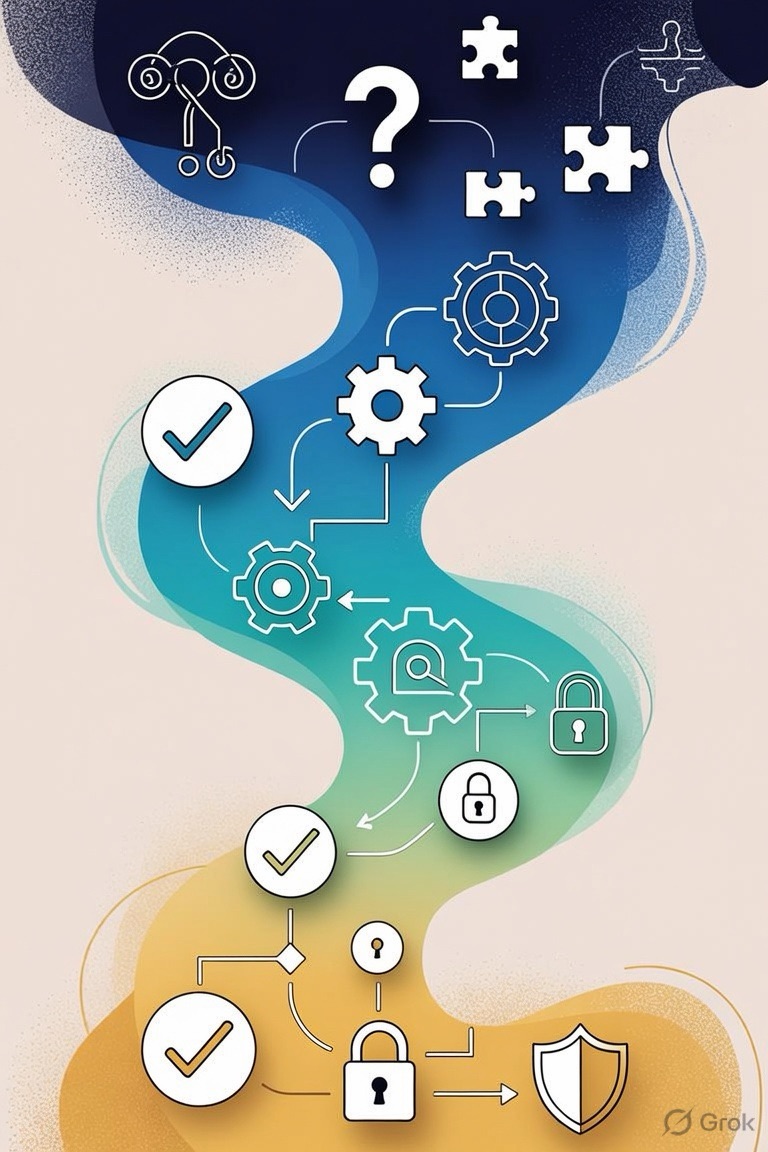
Progressive determinism is the process by which an organization initially handles uncertain situations adaptively and progressively converts recurring, well-understood, and valuable patterns into increasingly explicit, bounded, testable, and reliable mechanisms.
Determinism should be understood as a direction of travel rather than an absolute property. The objective is increasing explicitness, reproducibility, observability, and constraint wherever these improve quality, efficiency, and governance.
Humans and agents as collaborating actors
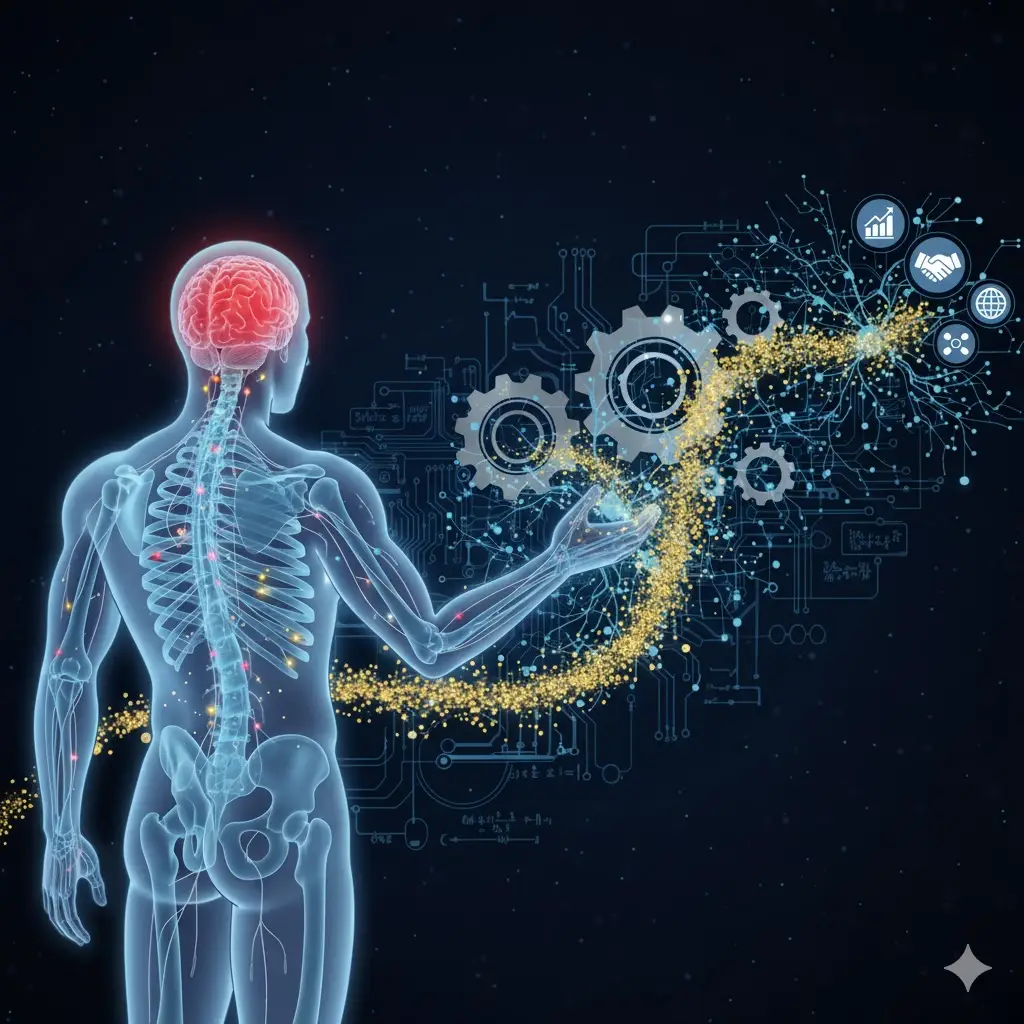
The basic unit of the future organization is not simply the human worker or the autonomous agent. It is the human–agent team.
Agents should not be treated merely as passive tools that wait for instructions, nor should humans be reduced to supervisors who approve machine-generated work. Both can participate actively in analysis, planning, execution, review, and improvement.
Within a human–agent team, an agent may:
- gather and synthesize information;
- continuously monitor organizational state;
- identify anomalies, risks, dependencies, and opportunities;
- generate alternatives;
- test assumptions and simulate consequences;
- coordinate tasks across systems and participants;
- execute authorized actions;
- maintain records and organizational memory;
- challenge human reasoning where evidence suggests an alternative; and
- learn from outcomes and propose improvements to processes.
Humans contribute capabilities that remain especially important where objectives, values, consequences, social context, or legitimacy matter. They determine intent, make value judgments, resolve genuine ambiguity, negotiate competing interests, exercise discretion, interpret social and organizational context, and accept responsibility for consequential decisions.
The relationship should therefore be closer to collaboration between capable participants than to a traditional user–software relationship.
In some tasks the human will lead and the agent will support. In others the agent will conduct most of the work and ask a human to resolve particular uncertainties. In many cases both will independently analyze a problem, challenge one another’s conclusions, and converge on a better decision than either could produce alone.
The objective is not maximum autonomy. It is maximum joint performance subject to appropriate accountability and control.
Authority and accountability
Collaboration does not imply equality of legal or organizational authority.
Agents can be delegated substantial operational authority, but ultimate accountability must remain with identifiable people or human-governed institutions.
Every material activity should therefore have a human accountability structure behind it. Depending on significance, accountability may rest with an individual executive, a directly responsible individual, a manager, a professional role, a board, or an explicitly constituted group.
For low-impact and reversible decisions, humans may pre-authorize agents to act autonomously within broad boundaries.
As consequences increase, human authority becomes progressively stronger.
For high-importance decisions, the system should preserve a clear principle:
Agents may analyze, recommend, challenge, simulate, and prepare the decision, but the ultimate decision authority remains human.
The highest-consequence decisions may require more than one human. Governance can require peer review, separation of duties, committee approval, voting thresholds, or other forms of collective authorization.
This preserves an essential distinction between delegated execution authority and ultimate decision authority.
An agent may be permitted to decide how to execute an objective within established boundaries. It should not, merely by virtue of superior analytical capability, acquire the authority to redefine those boundaries or determine matters whose legitimacy requires human judgment.
A continuum of execution
Work should be routed across a continuum according to uncertainty, consequence, reversibility, and maturity.
Adaptive execution
At one end are novel situations for which no reliable blueprint exists.
Humans and agents work interactively. An agent may investigate the problem, gather information, construct hypotheses, consult other agents or people, use tools, and propose courses of action.
The human may provide context unavailable to the system, clarify values and objectives, reject inappropriate assumptions, or make decisions where consequences exceed the agent’s authority.
This should resemble collaborative problem solving rather than simple human approval of an AI-generated answer.
Bounded adaptive execution
The overall process is understood, but some steps still require interpretation or judgment.
A workflow, state machine, or DAG defines the permitted structure. Within individual stages, humans, agents, or human–agent teams perform the work.
Authority can vary by step. An agent might autonomously perform research and reconciliation, jointly evaluate alternatives with a human, and then prepare a recommendation requiring human approval before execution.
This layer will likely contain a large proportion of organizational work because it combines efficiency with controlled adaptability.
Formalized execution
At the other end are processes whose important inputs, rules, outputs, and exceptions are sufficiently understood.
Conventional algorithms, rules, decision tables, and workflow engines execute these processes directly.
Humans and agents remain relevant primarily for monitoring, exception handling, audit, and improvement rather than routine execution.
The objective is not to make every activity deterministic. Strategy, negotiation, leadership, invention, crisis response, and genuinely novel situations may remain inherently adaptive.
The organisational control plane
Every significant request should enter through a common control layer that determines how it may be handled.
This layer establishes:
- identity and authority;
- the requested objective;
- relevant organizational policies;
- available context and evidence;
- uncertainty;
- potential consequences;
- reversibility;
- required expertise;
- required consultation;
- permitted agent autonomy;
- required human involvement;
- approval thresholds; and
- responsibility and accountability.
The traditional concept of a triager is therefore better understood as an organizational control plane.
Its job is not merely to decide whether a human or an agent receives the task. It determines the appropriate composition of the team and distribution of authority.
A request might consequently be routed to:
Agent only → Agent with human exception handling → Human–agent pair → Human with agent support → Human committee with agent analysis
depending on the nature of the decision.
Risk should be treated independently from technical complexity. A computationally difficult decision may be low consequence and safely automated. A trivial decision may carry enormous financial, safety, legal, ethical, or reputational consequences.
Autonomy should therefore depend primarily on factors such as impact, uncertainty, reversibility, precedent, and delegated authority.
Human–agent checks and balances
Human–agent collaboration can also improve decision quality by introducing deliberate checks and balances.
An agent need not merely support the human’s initial view. It can be instructed to search for contradictory evidence, test alternative hypotheses, identify hidden assumptions, estimate uncertainty, and explain why a proposed action might fail.
Similarly, humans should not automatically defer to agent recommendations. They should be able to challenge the agent’s assumptions, request alternative analyses, inject contextual knowledge, or require escalation.
Important decisions can therefore use structured disagreement:
Human proposes → Agent critiques → Agent proposes alternatives → Human challenges → Evidence is reconciled → Decision is made
or the reverse:
Agent proposes → Human critiques → Independent agent checks → Human decides
For sufficiently consequential decisions, multiple humans and multiple agents can participate, reducing dependence on any single individual’s or model’s failure mode.
The purpose is not ceremonial human approval. It is to use the different error characteristics of humans and machines to improve the quality of the combined system.
Organizational implications
Hierarchy historically performs several functions simultaneously: allocating authority, decomposing objectives, coordinating dependencies, allocating resources, resolving conflicts, aggregating information, monitoring performance, developing people, and providing accountability.
AI and software can increasingly perform substantial portions of the information-processing and coordination components. This creates an opportunity to reduce organizational layers, but it does not imply that the underlying management functions disappear.
The more useful objective is therefore management without unnecessary managerial intermediation.
Routine information aggregation, reporting, scheduling, status collection, dependency tracking, policy checking, and coordination can increasingly occur automatically through the organizational system.
Human leaders can consequently concentrate more heavily on areas where human judgment creates disproportionate value: strategy, prioritization, coaching, negotiation, conflict resolution, culture, risk acceptance, resource allocation, and accountability.
The likely result is not a completely flat organization, but a thinner hierarchy embedded within a much richer human–agent network.
Formal reporting lines may become less important for transmitting information because agents can make organizational state broadly visible. Authority structures, however, remain important because decisions still require legitimate owners.
This separates two concepts that traditional hierarchy often conflates:
information flow can become highly decentralized while accountability remains explicitly structured.
The learning loop
The defining feature of progressive determinism is not agentic execution. It is conversion.
Adaptive human–agent activity generates evidence:
- the situation encountered;
- the information considered;
- the actions proposed;
- disagreements between participants;
- decisions made;
- approvals obtained;
- execution steps;
- exceptions encountered; and
- outcomes achieved.
Repeated successful patterns become candidates for formalization.
A candidate pattern should then be codified, tested against historical and adversarial cases, evaluated for risk, reviewed by appropriate humans, versioned, and deployed into the bounded or deterministic layer.
The progression is therefore:
Novelty → Human–agent reasoning → Repeated pattern → Validated pattern → Formalized mechanism → Monitored execution
Human knowledge can become machine-executable structure, while agent discoveries can become organizational procedure.
This creates a compounding effect. The organization does not merely use AI to perform work. It uses AI and humans together to continuously improve the machinery through which future work is performed.
The arrow must also run backwards.
Markets change. Regulations change. Technology changes. Strategies change. Previously reliable assumptions fail.
Formal processes therefore require monitoring for exceptions, drift, degradation, and unintended consequences. When a deterministic mechanism ceases to perform reliably, it should be demoted into bounded or adaptive execution until it is understood again.
The complete cycle is therefore:
Explore → Learn → Formalize → Automate → Monitor → Detect change → Reopen → Learn again
Progressive determinism is consequently not a one-way march toward automation. It is a continuous movement between adaptive and formal modes according to the current state of knowledge.
The resulting organization
The end state is neither a conventional hierarchy augmented with AI assistants nor an autonomous swarm of agents.
It is a human–agent organization represented increasingly as an executable system.
Objectives, authority, policies, workflows, resources, decisions, organizational state, and accountability become progressively machine-readable.
Deterministic software executes what is well understood.
Agents interpret uncertainty, coordinate activity, monitor the environment, investigate exceptions, generate alternatives, and improve the system.
Humans and agents collaborate on complex work, frequently as intellectual counterparts with complementary capabilities.
Humans retain ultimate authority over the organization’s purpose, values, risk appetite, governance, and high-consequence decisions.
And every material outcome remains connected to an identifiable human or human-governed body that is accountable for it.
The fundamental operating principle is therefore:
Use deterministic mechanisms where the problem is understood; agents where interpretation, synthesis, or adaptability adds value; humans where judgment, legitimacy, values, or accountability matter; and human–agent teams wherever their complementary strengths produce better outcomes than either acting alone.
Progressive determinism is the discipline of continuously moving work toward the most efficient, reliable, and governable combination of humans, agents, and deterministic mechanisms that remains fit for purpose.